

Liberal Secularism and the Logic of Comparing Religions
Secularism subscribes to the conceit that it is superior to religion. But if that was sufficient, then why does it always place Islam as a competitor to Christianity and judge the latter as tolerant?


In the name of Allah, the most Gracious, the most Merciful
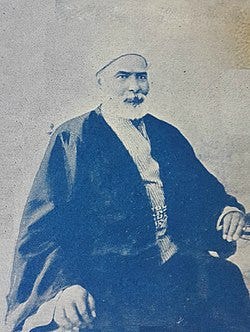
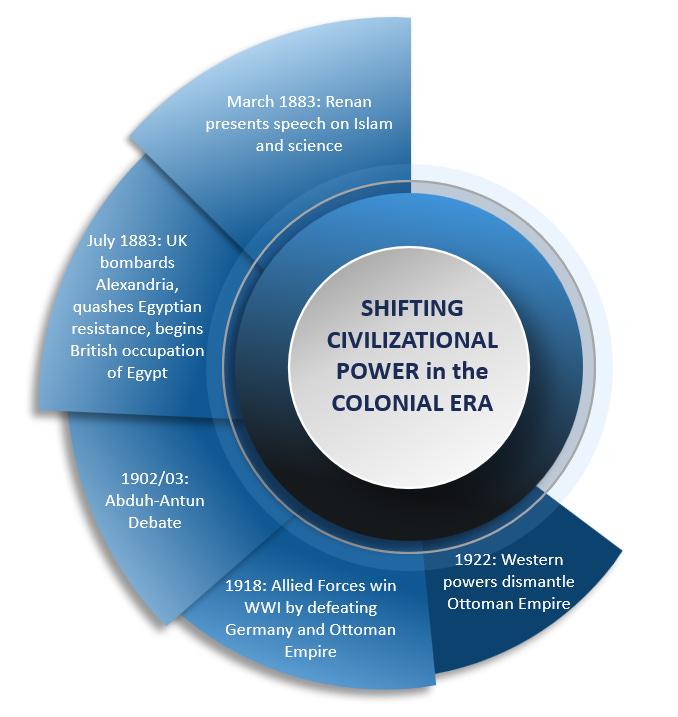
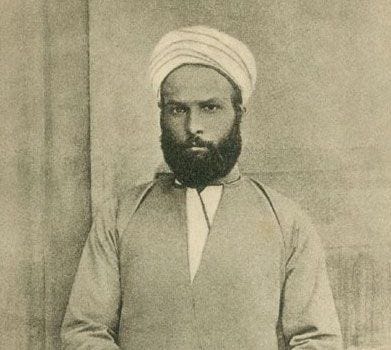
In 1902, the towering Egyptian scholar, Muhammad ‘Abduh, in a highly publicized debate, responded to a claim that Protestant European Christianity emerged from the Reformation more tolerant of differing opinions, science, and philosophy, than Islam. His rebuttal can only be described as staggering in terms of originality, accuracy, precision, and historical depth and breadth:
“I will not cite anything other than what the Protestants themselves have cited in their history of the Reformation (al-Iṣlāḥ). Their law continued (istamarrat) to rule for punishing by execution each heretic who dissents from orthodox theological belief (kul man yukhālif mu‘taqid al-ṭā’ifa). Indeed, the two Christian religious powers (kalifān) commanded that Servetus be burned at the stake in Geneva…” (Muhammad ‘Abduh, al-Islām wa al-Naṣrāniyya maʿa al-ʿIlm wa al-Madaniyya, 1902, translation and bolding mine)
Since Geneva was Calvinist (Protestant) at the time, ‘Allamah ‘Abduh’s conclusion--that the two leaders (kalifān) of Protestantism (Luther and Calvin) both persecuted any unconventional beliefs or opinions (dissent and heresy)--agrees with modern experts.
According to the Calvin University’s Henry Meeter Center, the Spanish physician and cartographer Michael Servetus deviated from Christian doctrine by believing Jesus Christ was not eternal and not God the Father. “This unorthodox interpretation of Trinity led to a common desire on the part of both Roman Catholics and Protestants alike to jail Servetus, put him to death, and to destroy his writings.”
Calvin himself ordered the imprisonment of Servetus in August 1553, and the Council of Geneva decreed he be burned alive at the stake on October 27, 1553. In December that year, the ecclesiastical court presiding over Servetus’ region announced a posthumous condemnation of his ideas and written works.
Why is this aspect of ‘Abduh’s thought so important?
Never did the Muslim world submerge into the carnage that Christian Europe unleashed on its own inhabitants for unorthodox beliefs. From the fourteenth to the seventeenth century, Europe executed, mostly by burning, between 40,000 and 50,000 people accused of witchcraft (a type of heresy). France condemned a woman, Joan of Arc, to death in 1431. The philosopher Giordano Bruno was set on fire by the Roman Inquisition as a heretic for supporting Copernicus’ planetary system. And even in England, where burning was rare, dissenters such as James Naylor were branded, bored by iron, and dragged through the streets as late as 1656.
These sentences punished people for beliefs that are now common in both the Western and non-Western world. Servetus was killed for a belief resembling a tenet of Islam that is normative to this day: that Jesus was a human teacher/prophet but not divine.
Ironically, Islam is the religion whose law restricted the use of fire—the most brutalizing form of torture that exists—as a tool of warfare or criminal punishment, but it is the least respected faith today and the one that the modern West spends the least time trying to understand and correctly represent.
Indeed, Shaykh ‘Abduh, who held the position of Grand Mufti of Egypt, did not only demonstrate a mastery of the intricacies of Christian theology and European history. In the publication he founded with Rashid Rida, al-Manar, his written exchanges with the Lebanese-Syrian Christian journalist Farah Antun revealed that Antun’s argument was more intent on comparing Christianity favorably than bettering society through secular reform.
Antun’s injection of the Western religious (Christian) past into the mix encouraged a series of destructive assumptions. His perspective erased Christianity’s long history of persecuting divergent opinions and fellow believers of different sects, Europeans’ internal religious warfare, and the Crusades. His account then relied on that whitewashed history to elevate Christianity (based on a triumphant Reformation) above Islam in terms of respecting knowledge and freedom.
In contrast, ‘Abduh went on to dispute Antun’s general claims with specific historical evidence. He pointed out that the Reformation’s main architect, the theologian Martin Luther, instead of appreciating knowledge traditions, represented the fiercest repudiation of Aristotle’s philosophy. Luther called the ancient Greek scholar a slanderer and a godless man. In contrast, when Muslims read and studied Greek works, they honored Aristotle with the designation, “the First Teacher.”
Secularism: A Refuge for Christian-supremacy today
As I listened to a podcast last week, I heard the guest interviewed (a psychologist) say that religions, like individuals, jockey for power and make claims about their superiority. In other words, when people speak about their belief systems in connection with alternate faiths, they place religions into comparison to win converts or compete with one another. From that ground, faiths cannot help us find deeper meaning because they are too busy proving their own supremacy.
But even if that assumption is true…and by not listening to religious proponents altogether, we can avoid their ploy to dominate us…do we then avoid the greatest harm facing us? Is there nothing more important to do right now than silence other people?

Unabashedly, the modern logic and rhetoric of liberalism subscribes to this conceit—that secular society is the superior and only egalitarian framework. But if that was sufficient, then why does liberal secularism always place Christianity in competition with Islam and consider the former more tolerant? And although that social order theoretically accords space to personal faith in the private sphere, the attitude that Christianity, not Islam, should be credited with establishing freedom and toleration would prevail in the public sphere and inform the daily interactions between all citizens. That is indeed the prejudice that has come home to roost.
But this bias also actively hinders us from resolving our political and social conundrums. The dueling antagonism between conservatives and liberals is a reality. So are the more specific polarizing issues we face, whether we consider how taxpayer money should be spent: on education and health care or military support of Israel? Or whether we should expand or cut federal programs that serve the poor and disabled? Do we fund international relief organizations or cease medical and food aid to Gaza, Sudan, and the Congo?
These are the true clashes in the political, economic, and social order for which we have no compromises or reconciliation. Yet the language and theoretical framework of secular reform continues to cast Islam as the shadow-side of Western modernity. Meanwhile, the obsession over secular/religious superiority does little to improve our prospects, our everyday lives, and our socio-political reality.
As ‘Allamah ‘Abduh aptly understood, the modern language of secularism is applied to Islamic civilization like a bludgeon, weaponizing all frameworks—liberal and conservative, humanist and religious—in collusion against Islam to convince Muslim societies that their faith is the lowest rung of the ladder.
Instead of accepting such sweeping stereotypes about religion, we have a unique opportunity at this moment to dismantle colonial frameworks and narratives, especially given that global opinion is shifting towards recognizing that Israeli Zionism has bred lies about and committed depredations upon the people of Palestine under the guise of an egalitarian, democratic, secular nation-state.
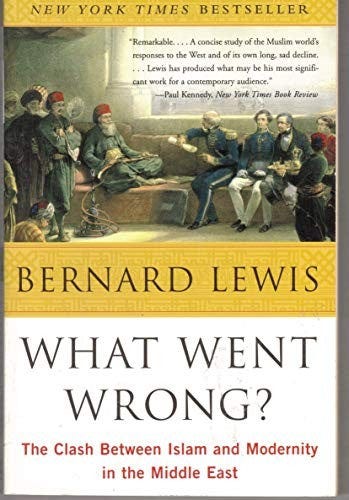
Consider how the doyen of Middle East and Islamic studies, the British Orientalist and Zionist Bernard Lewis, placed Muslims on a collision course with contemporary secular democracies and situated them as “irrational” rivals of a homogeneous Judaic-Christian past:
“It should by now be clear that we are facing a mood and a movement far transcending the level of issues and policies and the governments that pursue them. This is no less than a clash of civilizations—the perhaps irrational but surely historic reaction of an ancient rival against our Judeo-Christian heritage, our secular present, and the worldwide expansion of both. It is crucially important that we on our side should not be provoked into an equally historic but also equally irrational reaction against that rival.”
These words, penned in September 1990 for an article in The Atlantic, first coined the term “Clash of Civilizations” to characterize the relationship between the West and Islam as hostile, catching the attention and imagination of Samuel Huntington. Despite his seeming caution not to provoke an “equally irrational reaction against that rival”, Lewis was vocal in calling for war against Iraq in 2003—a nation that did not have weapons of mass destruction.
Using his credentials to open channels for him all the way to the top of US intelligentsia, Lewis had the ear of the White House and the Pentagon, and he pressed his advantage. He was instrumental in bringing about the US decision to invade Iraq.
And what was Lewis’ not-so-secret power of persuasion? The instrument of comparison.
Lewis worked Judeo-Christian religious supremacy into his paradigm of a secular society in which some religious traditions (Western) belonged and one (Islam) did not.
In this way, universal statements about religion, rather than helping most of us coexist, now routinely aid and abet Israeli Zionism, shoring up the humanitarian crisis and massacre that Israel deliberately and daily manufactures and systematically deploys against Gaza and the West Bank.
Now is the moment to confront Western modernity’s stereotypes; it could not be more urgent. Israel’s genocide of Palestinians pulls back the curtain on the platitudes and abstractions about religion sanctified by liberal secularism.
As further proof that contemporary Islamophobia is informed by the millennium-long relationship between Islam and the West, in September 1990 Bernard Lewis expressed a sentiment that was first expressed almost word for word by Antun, namely, that early Christianity, unlike Islam, was the origin of modern secularism.
In other words, Christianity, from the purity of its beginnings, had within it the seeds of a society that could embrace all people because it successfully separated Church and State—a feat that Muslims had allegedly not accomplished.
Lewis’ article, “The Roots of Muslim Rage”, published in The Atlantic, is infamous today.
Samuel Huntington not only derived his thesis from that essay but actually borrowed the exact title—"A Clash of Civilizations”—from the heading Lewis chose for the section on the origins of secularism in Christianity (below).
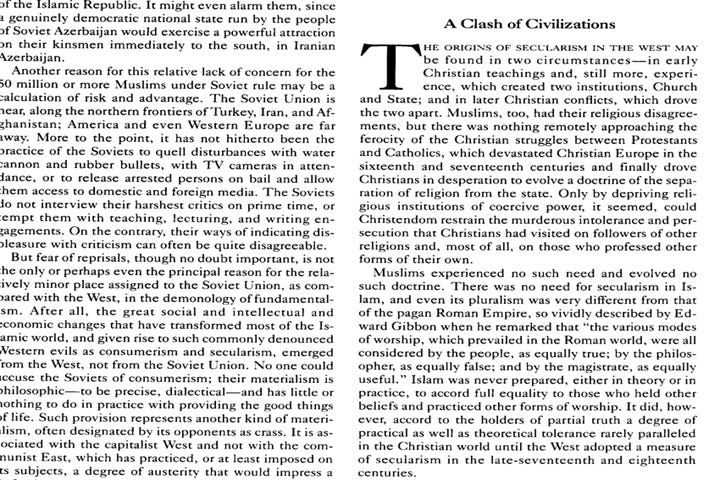
Although he doesn’t admit it in his writings, Lewis’ argument was taken almost verbatim from the prominent religious and political exchange in Egypt at the turn of the twentieth century between two Mediterranean Arab men of letters—the Grand Mufti ‘Abduh and the journalist Antun.
In 2003, encouraged by the acclaim of Huntington’s 1993 Clash theory, Lewis reproduced and expanded upon his Atlantic article in a new book vilifying Islam and Middle Eastern populations—The Crisis of Islam: Holy War and Unholy Terror.

Following Antun’s bid to invoke the Reformation, Lewis also cast Protestantism as the gentle face of religion, hiding the savagery of the Reformation’s theological condemnations and fixation on hunting and prosecuting heretics, and rewriting that extreme theological intolerance into the narrative of Muslim civilization, where it had not historically occurred:
“The Muslim fundamentalists, unlike the Protestant groups whose name was transferred to them, do not differ from the mainstream on questions of theology and the interpretation of scripture…Fundamentalists are anti-Western in the sense that they regard the West as the source of the evil that is corroding Muslim society…” (Bernard Lewis, The Crisis of Islam: Holy War and Unholy Terror, 2003)
Lewis’ depiction of Protestantism blurs its origins and context—its historically warring theologies, intolerance of difference, and burning alive of heretics at the stake. The account is historically, intellectually, and ethically dishonest, hewing closely to extreme right-wing Christian and secularist bias.
Professor Hamid Dabashi aptly captured the imperial and colonial nature of Lewis’ scholarship in an eloquent 2018 Aljazeera op-ed, commenting: “Just imagine: What sort of a person would spend a lifetime studying people he loathes?”
Within his project, Lewis found a chance to explore a scriptural and historical link between Christianity and secularism. He would analyze the Biblical verse “Render unto Caesar the things that are Caesar’s, and unto God the things that are God’s.”
In fact, Lewis lifted this idea straight from the renowned Arabic 1902 debate that took place in Egypt. Both in his Atlantic article and the later book, Lewis drew on Antun’s argument in the Egyptian debate, demonstrating a Zionist/modern concern in returning to the Arabic intellectual exchange, although he had branded the Muslim world a place of unreasoned hatred. And instead of Antun’s moderate tone and the respect shone towards ‘Allamah ‘Abduh, Lewis formulated his 1990 and 2003 two-pronged claim about Islam with ferocious certainty, concluding that Islam was both hostile to secularism and a less tolerant “irrational” rival to Judeo-Christian heritage.
As Mohammad Magout has observed, “There is rarely a study of the debate between secularism and Islamism in the Arab world that does not mention the famous exchange.”
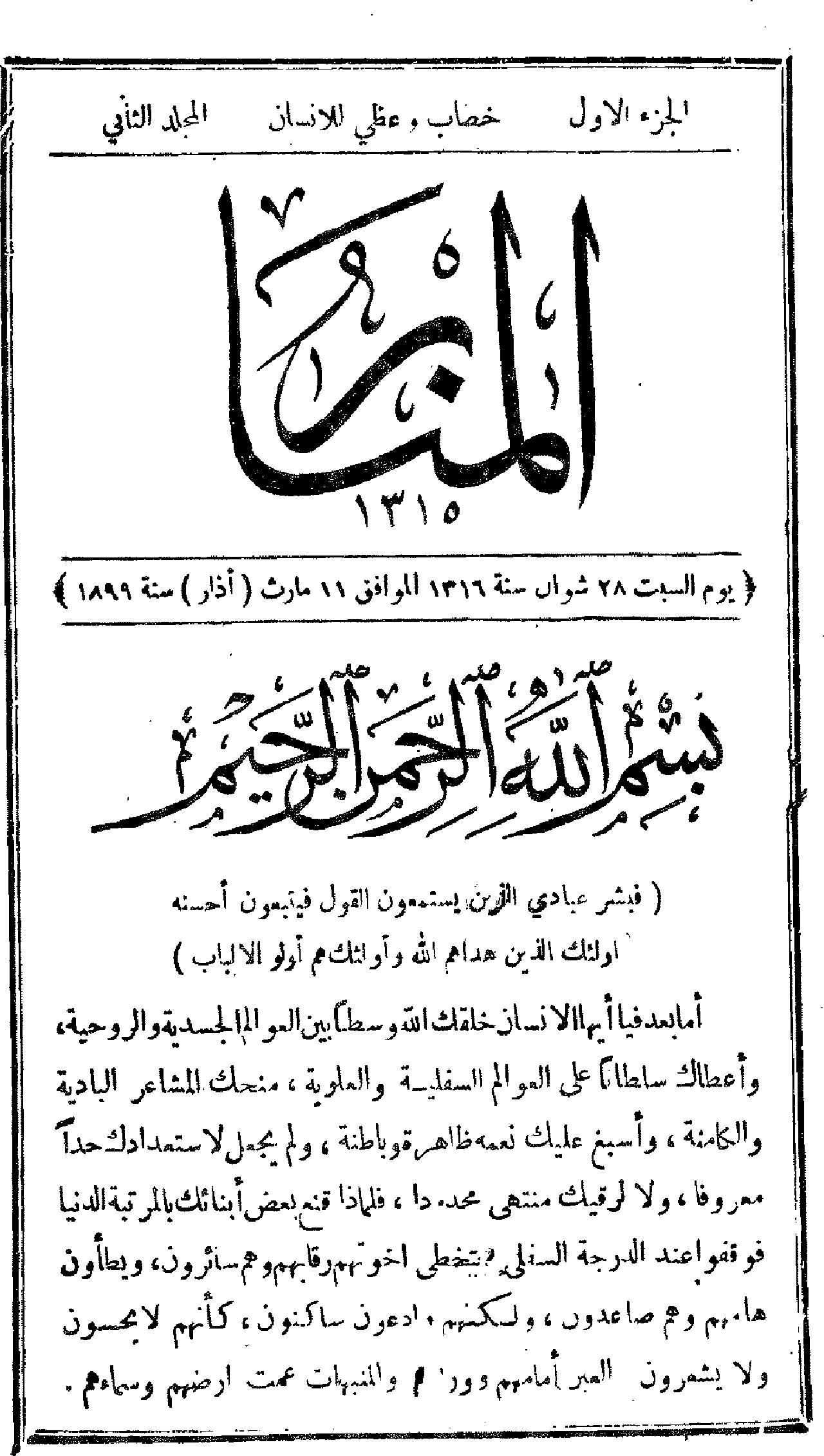
Like Antun, Lewis rested his argument that Islam was averse to contemporary secular society and modernism on the false assumption that its past was less tolerant than Christianity’s. Indeed, the clash of civilizations assumption that has preoccupied advocates of Western reform models thus has its roots in premodern Christian experience.
Ironically, Islamic civilization worked out a theological response to reconciling the Stranger—an intellectual feat that explains why the demonization of others that characterized premodern Christian Europe never occurred in Muslim lands. Read my post on that topic here.
In the next post, God willing, I review the take-away points of the celebrated 1902 exchange in the Arabic republic of letters and how Lewis was careful to ensure his own work was informed by Shaykh ‘Abduh’s brilliant responses to Antun in the appraisal of Christianity, secular reform, and Islam.
Thank you for reading.
Thanks for this, I never thought about the influence of Lewis like that. It makes me feel icky at the colonial framing that he engaged in, and I find the hypocrisy of the west on this matter some of the most difficult things to reconcile about the liberal secular establishment, especially in the university system. The concept of "fundamentalism" I feel also has to be reevaluated. Maybe there is more to Lewis and his project than first meets the eye, but it does not look good and the fact that he touted the intolerance of the muslim world while at the same time stoking a crusade is really disgusting.
jazakallahkhair, may Allah bless your efforts.