

Liberal Secularism and the Logic of Comparing Religions, Part 2: Bernard Lewis' appropriation of Muhammad Abduh's 1902 Egyptian debate
Abduh showed colonial-era Egypt continued Islam's tradition of prioritizing reason in disputes with revelation. Ironically, Lewis erased Islam's reconciliation in favor of a 'clash of civilizations'.


In the name of Allah, the most Gracious, the most Merciful
In the first decade of the twentieth century, Islam’s most prominent mujaddid (renovator), explained that, “if conclusive reason contradicts the transmitted details of revelation, reason is given preference” (itha ta‘arad al-‘aql wa al-naql akhatha bima dall ‘alaihi al-‘aql). [translation by Mohammed Gamal Abdelnour and Umran Khan]
The Egyptian Grand Mufti Muhammad Abduh declared, amid the age-old dispute between revelation and intellect, that Islam’s religious sciences established we can never do away with reason.
Not only had Muslim scholars worked out that position as a consensus (ittafaq ahl al-milla al-islamiyya) over the course of centuries, but Abduh showed that Egypt’s Islamic tradition preserved that legacy and applied it well into the colonial period. Abduh made the statement as part of his highly visible and publicized 1902/03 exchange with the Lebanese-Syrian Christian journalist Farah Antun.
As Abduh clarified, Islam’s scholarly tradition thus allowed discarding a transmitted meaning of Scripture when it was speculative, lacked a clear, apparent (thahir) proof, and opposed reason/intellect. Through that move, Muslim scholarship recognized that human interpretation of the revealed text is limited, cannot always or fully grasp Allah’s wisdom, and, in general, subject to error. Hence, the need for rationality, without despairing of reaching the truth.
In this way, Shaykh Abduh elaborated (and recorded in print media) the inseparability of rational deliberation and Islam’s religious sciences throughout their long history.
But if that was the manner Abduh framed his response, it was not the one posed by Antun to initially set the debate in motion. The journalist had claimed that Islam was oppressive to science and philosophy because it never disentangled religious authority from political office. He then went on to say that the West’s advancement of reason and knowledge rested on the biblical verse “Render unto Caesar the things that are Caesar’s and unto God the things that are God’s.” According to that argument, Europe tolerated science and differences of opinion by severing the union between Church and State.
“Civil and religious authority are closely tied together in Islam by the rule of revelation and, therefore, the general ruler is both governor and caliph in one. Consequently, this makes religious toleration harder to come by [in Islam] than it is in Christianity, wherein there took place an unprecedented separation between the two aforementioned fields of authority, which paved the way for the world towards true culture and true civilization. This took place with a single phrase: ‘Render unto Caesar the things that are Caesar’s and onto God the things that are God’s.’” (Farah Antun, 1902, al-Jami‘a al-‘Uthmaniyya, No.8)
The Clash of Civilizations
When Bernard Lewis wrote his infamous Atlantic article on secularism and Islam in 1990, he returned to Antun’s point and the formative controversy in the Arabic republic of letters. Lewis argued that the Bible’s prescription ‘render…unto Caesar’ established early Christianity as the source of modern Western tolerance.
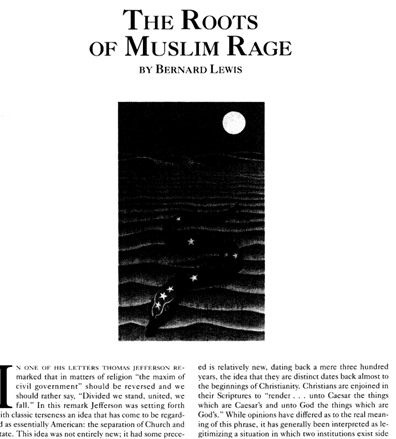
This aficionado of Middle Eastern studies, however, never mentioned Allamah Abduh, Antun, or Egypt’s celebrated intellectual exchange by name. And by dropping Abduh’s responses completely and restoring Antun’s view as the last word, Lewis jettisoned Abduh’s role in the 1902 debate. As a result, Lewis’ appropriation of the argument utterly erased the content of Shaykh Abduh’s remarkable contributions from the centrality they enjoyed in their original context.
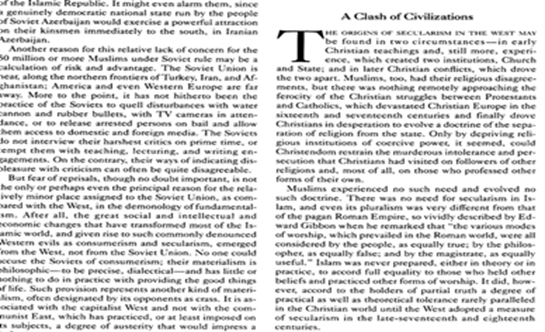
In the same Atlantic article, Lewis inaugurated the Clash of Civilizations argument later developed into a full thesis by Samuel Huntington.
“It should by now be clear that we are facing a mood and a movement far transcending the level of issues and policies and the governments that pursue them. This is no less than a clash of civilizations—the perhaps irrational but surely historic reaction of an ancient rival against our Judeo-Christian heritage, our secular present, and the worldwide expansion of both. It is crucially important that we on our side should not be provoked into an equally historic but also equally irrational reaction against that rival.” (Bernard Lewis, “The Roots of Muslim Rage”)
In fact, the “irrational” depiction of Muslims was a significant part of Lewis’ agenda to establish that Islam was violent and that it was hostile to European modernity and Judeo-Christian heritage. Yet, in the very debate in the Arabic republic of letters that started the discussion on Islam and modern reform, Abduh’s response, like Islam’s one-thousand-year intellectual legacy, had never relinquished reason and rational deliberation. In fact, the Islamic tradition, by consensus of the ulama, held that Scripture and intellect were interdependent.
Muslim scholars had worked on the problem most likely to aggravate that relationship—the particular issues on which a conflict did arise between revelation and reason. Islamic civilization thus ensured that reason was indispensable, so that there was no clash between the transmitted details of revelation and human reason.
Lost to History
Indeed, the Grand Mufti’s work, like Islam’s commitment to reason, has been lost to history. In fact, it is only this year, 2025, that an English translation of Abduh’s al-Islam wa al-Nasraniyya: Ma’a al-‘Ilm wa al-Madaniyya (Science and Civilization between Islam and Christianity) has been completed. The book was posthumously published in Arabic by Abduh’s colleague Rashid Rida as a compilation of all six essays rebutting Antun originally printed in Abduh’s reformist journal, al-Manar (The Lighthouse). In two of the original articles, Abduh addressed Antun’s “render unto Caesar” argument with a point-by-point analysis.
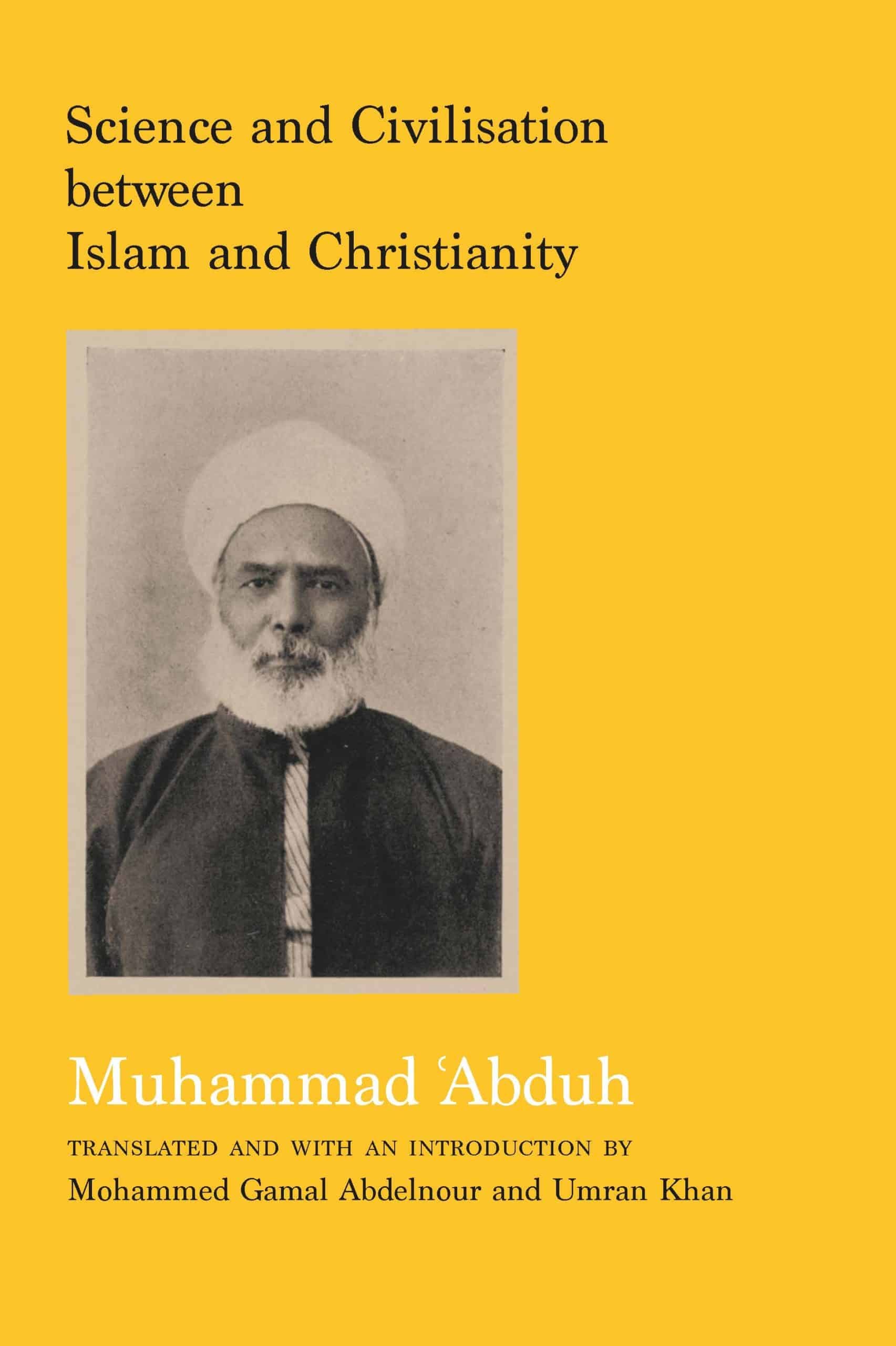
According to the two scholars of Abduh responsible for the new English edition of the book, Mohammed Gamal Abdelnour and Umran Khan, al-Islam wa al-Nasraniyya “is one of his most famous works” and yet it has been more “presupposed” than studied and “discussed”. The fact that it has never been fully rendered from Arabic into English until now supports that conclusion.
For now, if we want to understand why Bernard Lewis returned to the Arabic debate of 1902 but was not forthright about the fact that he drew on it, we must also return to what Lewis left out— the content and context of Abduh’s published writing. The rest of this post delves into the content, and a subsequent article will explore the context.
Since Abduh’s entire discussion cannot be summarized here, only the most important segments of his rebuttal will be covered.
“Indeed, in Islam, no one was ever burned at the stake for heretical beliefs”
Specifically, the following counter-arguments on the status of reason, freedom of thought, and toleration in Islamic tradition aimed at correcting Antun’s misinterpretations of Christian and Islamic history:
First, Antun had presented an argument that Islam was inhospitable to science and philosophy. His evidence, however, rested on one example: the Andalusian Muslim philosopher Ibn Rushd. The Hispano-Arab philosopher became known in the Latin West (as Averroes) for his famous distinction that elites applied philosophy to reach the truth while ordinary folk could only reach the truth through religion. On that account, Western Europeans thought that when Ibn Rushd warned elite classes not to dismantle religion, it was due to his conviction that the masses had no other route to reaching valid conclusions, not because he thought Islam was superior to philosophy/secularism. At the end of his life and for a variety of reasons, Ibn Rushd lost his position at the royal court for a period of two years, and his books were burned by the Almohad caliphate.
In response, Shaykh Abduh pointed out that this “humiliation” of Ibn Rushd represented one poor decision by one authoritarian ruler. More importantly, he demonstrated the extent of Antun’s historical blind spot by declaring that “indeed, in Islam, no one was ever burned at the stake for heretical beliefs, whereas how many has Christianity condemned to such a fate?” (anna al-Islam lam yahkum bi-ihraq ahad limujarad al-zaygh fi ‘aqidatihi, wa kam hakamat al-mesihiyya bi-thalika?) Ibn Rushd was neither condemned to death nor charged with heresy/apostasy, so Abduh asked, which religion then was more tolerant? This point worked into Abduh’s next refutation, discussed below.
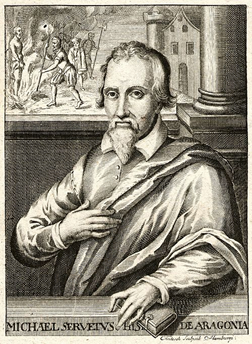
Second, Abduh demonstrated the extent his opponent’s position lacked historical grounding. Antun ignored centuries of torture, executions, and expulsions of populations who rejected or dissented from Christian belief under European empires which had not followed the biblical teaching that called for separating religious and temporal power. Abduh pointed out that hundreds of thousands, if not millions, of people who refused to conform to orthodox belief under the Spanish and Holy Roman Inquisitions were put to death. If that one command in the Bible had been enough to protect those of unorthodox beliefs, then why did it not suffice to prevent the burnings and executions that occurred from prosecuting heresy?
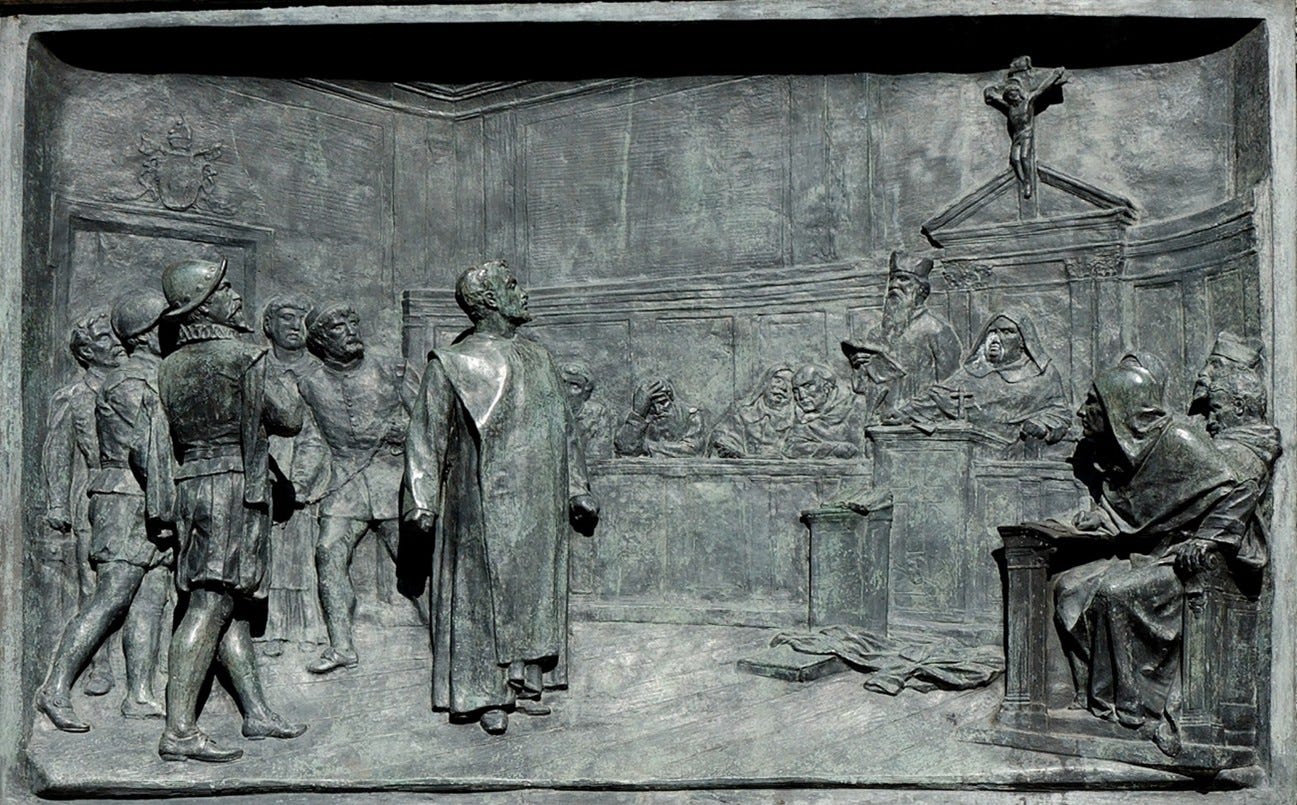
Third, Abduh explained that, in Islam, burnings and executions never occurred for a combination of reasons. For one, scholars came up with many diverse yet accepted legal reasons for not prosecuting or punishing heresy. For another, the category ‘heresy’ was used for civil, temporal, and practical concerns (such as identifying those whose creed was invalid so that one could avoid marrying or conducting business with that individual). The category ‘deviant in belief’ or ‘heretical’, then, was not for establishing eternal salvation or criminal legal status because the people of Egypt had accepted them in their midst.
“…the jurists of our community unanimously agree that those two denominations are comprised of apostates and heretics—their slaughtered meat cannot be lawfully consumed and they are not allowed to marry Muslim women…Yet, they live amongst the Muslim, and have done so for over 900 years, and they continued to live under Muslim rule when it was at the height of its power.”
(Muhammad Abduh, 1902)
As Abduh observed, if the ‘Render unto Caesar’ teaching was one command ordered by Christianity, Islam’s Scripture had two commands whose implementation had real historical significance for the enterprise of science and philosophy—the principle, there is no compulsion in religion (la ikraha fi al-din, Sura al-Baqara 2:256), and the worldview stating that reason and the natural world are resources that help us obtain information and validate knowledge since we are told we can attain the truth, which is from Allah (wa qul al-haqq min rubikum, Sura al-Kahf 18:29).
Fourth, Abduh highlighted the fact that there had never been a war amongst Muslims either for adding to removing any theological doctrine. This is true for the entirety of Islam’s history.
Finally, Abduh presented a surprising argument about how Muslim society identified but accommodated people of divergent beliefs and unorthodox creeds without violence. Yet, what he spoke of here was not Islam’s ulama or religious leadership but the general population of Muslims.
“Now we transition from these two principles to one which is popular amongst the Muslims and is known to be one of the fundamental rules of their faith: if someone says something that could be interpreted a hundred different ways to have been blasphemous, and there is only one way to have not been so, it is interpreted in the one way to have not been so, it is interpreted in the one way which precludes blasphemy, and it is not allowed to interpret it in any way that is blasphemous.”
“…have you heard anything from even the philosophers which is more tolerant than that?”
(Muhammad Abduh, 1902)
According to the Grand Mufti, the unanimous agreement on a theological creed reached by Muslim scholars provided groups and individuals who held unconventional beliefs a refuge and protection within the Muslim community. (I have dedicated a series of posts to that unprecedented fourth AH / tenth CE -century theological consensus. You can read the final post, which deals with the most well-known version of the Islamic creed—the Egyptian theologian Imam Tahawi’s ‘aqida—here.)
What was (and is) surprising in Allamah Abduh’s discussion is the orientation he brings to the common masses of Muslims and the contemporary people of Egypt. In his writing, they constitute a historical community and continuity of Islamic practice and lived experience, not of religious elites or educated leaders, but of ordinary citizens learned in the art of coexistence and steeped in a culture of providing sanctuary and asylum to people who might not share their beliefs and identities.
Today, in an age that has taught us that Israeli Zionism could not have wreaked such havoc on Palestinian life, dignity, and wellbeing without the immense support of the US’s Christian right, it is fitting that I end with a question Shaykh Abduh posed for Antun that is still relevant today:
“So, I ask, has there ever been such a social contract [as Islam’s] shown in the past by Christian society?” (fahal ‘ahida mithl thalika ‘ind al-mesihiyyin?)
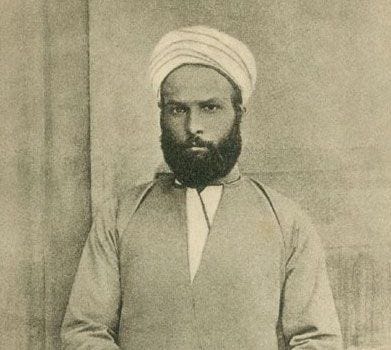
What was left out of Bernard Lewis’ portrayal of clashing civilizations was this, Abduh’s magnificent, reasoned 1902 exposition and rebuttal.
In response to Antun’s rosy picture of Christian Scripture and modern Europe, Abduh had to reframe the debate to show that the greatest threat to society was not that an intolerance of science/philosophy caused religious oppression to grow. The greatest fears about the future stemmed from Christian and Western historical experience and their history of theology—namely, a theology of heresy which had expanded without limit to persecute a larger and larger pool of groups and individuals.
Along with that consequence of dualism, neither Christian theology nor European political power offered a mechanism to restrict or ban the agonizing suffering that was inflicted on those who held deviating beliefs. Heresy was prosecuted by burning at the stake by both Catholics and Protestants. And with the rise of Protestant liberalism, the earlier Christian theology of heresy survived and entered modern Western lore to misrepresent Islam and dehumanize Muslims.
With wisdom and historical acuity, Allamah Abduh was able to show that the European colonial project and modern Western secularism had kept alive an artifact of Christianity’s medieval and early modern persecution of unorthodox groups and individuals. Yet he repeated the sentiment throughout his writing that he did not mean to insult and attack any culture or civilization. He meant only to present an honest account of history that spoke to relevant issues and attempted to alleviate modern problems. European colonization and secularism were in the process of casting the disenfranchised masses of the Muslim world as Strangers, outside of the social contract.
Thank you for reading.