

A Valedictorian Nothing
I was a model straight A student, but as a brown Muslim girl, my effort didn't save me from being pulled out of class and publicly beaten by school admins for a minor offense (talking in class).

Young children don’t have the ability to express in words everything they experience. Therefore, an event that triggers more complicated and painful emotions, ironically, remains inaccessible. Illiteracy thus makes children more susceptible to exploitation—on two different levels. To be able to receive help, a child would first have to recognize that someone is doing something to him/her that violates the norms of what is acceptable. Second, a child has to articulate what is a complex experience without being able yet to rely on complex or fully-developed expressive language resources.
So, the more children are submerged in illiteracy, the farther they are stranded from the law’s protection.
But that is only ONE of the problems we face in ensuring young people’s safety. The other has to do with the fact that we obviously cannot prepare our children for all the circumstances they will meet. And we certainly can’t give them a language for experiences that we ourselves are not familiar with.
Anti-Islamic prejudice in schools, with all its attendant harms, has become such a surreal part of life for American Muslim families.
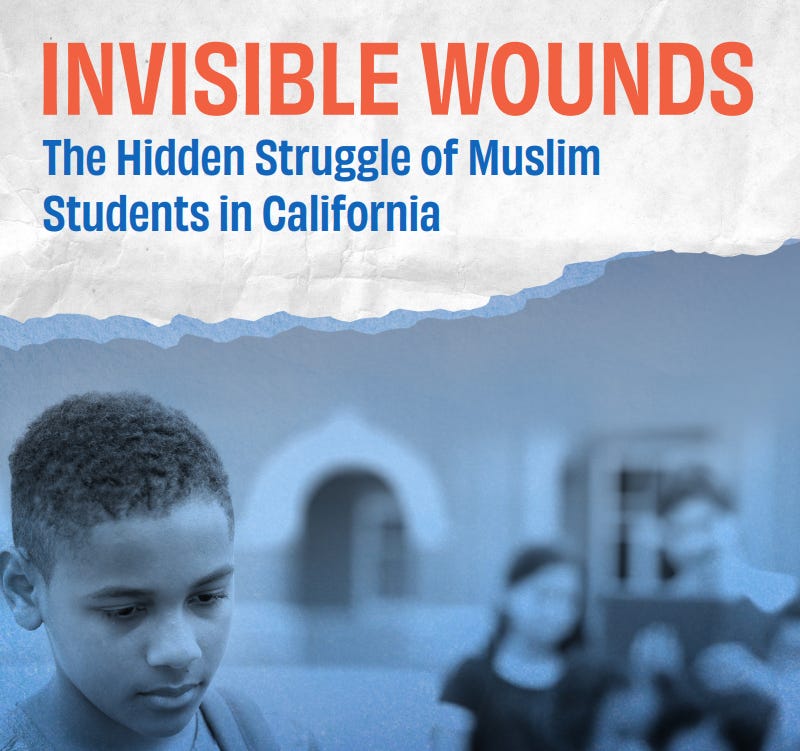
The Council on American-Islamic Relations (CAIR) has documented that Muslim children are bullied at twice the national rate. A report by The Institute for Social Policy and Understanding (ISPU) agrees, finding that 51% of school-age Muslim children in the US report religious bullying and harassment, almost double the percentage of children in the general public (Natasha Tariq, January 25, 2022, https://www.ispu.org/10-needs/). More disturbing, school administrators or teachers are responsible for 30% of these incidents. This climate might explain why, as the 2025 CAIR report just released for the state of California alarmingly cites, 67% of Muslim youth do not report their experiences of discrimination, verbal abuse, exclusion, threats, and physical harm in the public school system.
29% of students reported experiencing school staff making offensive remarks or displaying inappropriate behavior toward Islam or Muslims. (Compare to 25% from the 2023 Report) — CAIR 2025 Bullying Report
“Kids in the school made fun of my religion… They called me all the negative words about Islam and Muslims, like: terrorist, bomb girl… sometimes, I am bullied for being Muslim, or for being Indian, or for both Muslim and Indian at the same. It’s hard and even very hard, the parts of your identity that you love the most are not respected and valued in my school… and the comments they say are hurtful.” —Layla, a 10th grade student in high school
“I experienced cussing, insults, and jokes about Islam and Muslims.” —Ahmed, an 11th grade student in high school
“It’s scary how my well-being doesn’t matter to the school and district leadership… I hate being seen as a threat while I am not… After that incident, I experienced intense emotions and exhibited unfamiliar behaviors such as fear, anxiety, withdrawal, and a desire to escape and not be seen.” — Mariam, an 11th grade student in high school
These comments are from high-school students. Thankfully, they have found their voices. But nothing has been done to resolve their pain. Now we need to listen.
These students’ courage in coming forward should lead us to ask: How many others are still voiceless? Younger children are caught in the same trap—a creeping Islamophobia that has made its way inside the classroom. But smaller children do not yet wield the power of language.
Considering the US’s transparent military funding and political support of Israel’s genocide against Palestinians (which emboldened the slaughter of tens of thousands of innocent children), it is abundantly clear that we have our work cut out for us: America’s public education system must see anti-Islamic bullying within its own walls, and the risks it poses to Muslim youth, as a problem.
Because, as long as threats against Muslims are tolerated and viewed as acceptable, we will not be able to give our younger children, our immigrant children, a language with which they can appeal to the law’s protection.
As I read these brave high schoolers’ accounts of their everyday pain, I feel both heartbreak and connection. They are decades younger than me, younger than my own adult children. I cannot help reliving my own experiences as a young immigrant entering public school. I went through Islamophobia before there was a word for it. Before I had a language that could explain the shunning and dehumanization of the young. Before I could understand the long, long trajectory of Christian white national supremacy and its willingness to indoctrinate its own at tender ages.
It is in solidarity with what Muslim children confront today, on their own, within the halls of education, that I share a small part of my childhood experiences. It is not meant to cast aspersions at my American schooling in its entirety because I had many, many extraordinarily caring, inspiring, and dedicated teachers and, overall, I enjoyed learning. I also had a coterie of good friends whose camaraderie pulled me through low points. But it is equally true that the bullying, ostracizing, and social exclusion I lived through most days of primary education made getting up and going to school every day a monumental internal battle.
*The following is an excerpt from my Medium article, ‘As a Muslim child immigrant in American public school, I found no route’—
“On my first day in an American classroom, I heard the words “sand n*****” uttered by a blond boy in second grade who glared at me as I slid into the empty seat beside him. As a female child immigrant arriving from a Muslim-majority African nation (Egypt) in 1979, I was inextricably entangled in a history of race and gender. Mainstreamed into a Texas elementary school before I had learned English, I did the only thing I knew. I smiled and I nodded, manifesting the politeness my parents taught me. But I was churning inside.
Together, the ferocity of the look and the slur, passed down from one generation to another innocent one, emblazoned them in my memory although the word was not one I knew. Not one with which my immigrant parents were familiar. Nor one my first-grade teacher, Ms. Kerr, patiently recorded for me on a hand-held tape player to learn along with my mother’s list of Arabic phrases. For me, education in religious or racial consciousness was never punctual. Like my past, it could not prepare or buffer me from the onslaught of bullies and bigots. It is why W.E.B. Du Bois’s concept of a “double consciousness” cannot capture Muslims’ experiences of racialization. It was as if, when we entered the U.S., my parents and I had stood outside of history, and, then, in one instant, we stepped into the stream. We were then surely swept up in its fury.” — Reem Elghonimi
At its core, the othering of Muslim children and child immigrants is not something that can be explained from one generation to the next like black American identity. Not only could I not understand what that slur meant, but even if I learned what there was to know about African captivity and American slavery, I still would not understand for decades how it applied to me — why I was called that derogatory term and why I could be singled out for corporeal punishment (among others who also broke the rules) as a child. As long as there is no acknowledgement of the historical prejudice against Islam and Muslims, then it does not exist. And if it has no reality, there is no such thing as harassment of Muslims, young or old, in the US or in the nations that the US props up with its money, its bombs, and its UN veto.
We have a responsibility to support schools and teachers and ensure that teaching is a valued, dignified, and well-paid profession. Just as we have a responsibility to consider carefully the history and power of Western prejudices in the very institutions and roles in which they dominate and rule over those who are most vulnerable to historical dehumanization.
Thank you for reading.
The more we learn of American history the darker it becomes. And sadly, terrifyingly, there is a desire to return full force to those dark days. The title of your Posts, True Human, really urges one to consider, what is truly the meaning of human. Are we fulfilling our purpose in this life? Or redefining 'human' to satisfy our egos?