

The Orientalists' Extreme Skepticism of Hadith Wrought Disastrous Consequences for Islamic Law. It has stolen our intangible cultural heritage.
This is the insidiousness of epistemic attacks on Islam’s intellectual heritage. Shafi’i's al-Risala is the text whose longform use of reason was the artifact that Orientalists succeeded in burying.

“Whoever blasphemes the name of the Lord shall surely be put to death. All the congregation shall stone him.” (Leviticus 24:16)
Stoning was mandated in the Old Testament as a sentence for varied offenses from blasphemy and idolatry to adultery. Besides the passage above, it was ordered in Deuteronomy 17:2-5, Leviticus 20:27, Joshua 7:25, as well as in several other verses.
In Islam’s history, however, we find that Muslim scholars began the intellectual work of diminishing the application of stoning (Arabic rajm) in the classical period. The erudite legal scholar Imam al-Shāfiʿī was one of the first Sunni mujtahid scholars to operate within the parameters of Sacred Law towards such a goal (since we have a complete written record of his methodology). What made this more likely in the new religious context? Islam’s Scripture, the Qur’an, does not contain a single verse that establishes stoning as a punishment.


In the name of Allah, the most Gracious, the most Merciful
*This is the second instalment of a multi-part series that attempts to do justice to Imam al-Shāfiʿī’s unparalleled project and to address the magnitude of this topic. All good is from Allah, and all errors are my own. What I am presenting is a new historical argument, since I am trained in the history of Islam and the Near East, textual interpretation, and the flow of ideas and philosophies from the ancient to the medieval and modern world.
The work of Imam Muhammad ibn Idris al-Shāfiʿī, the Palestinian scholar originally from Gaza and one of the four founders of the Sunni eponymous schools of law, in the treatise entitled al-Risala, has long been considered legal theory (usul al-fiqh or the roots of jurisprudence). Yet, as part of explaining how to formulate legal opinions or rules—which faqihs could then use to address local believers’ questions—this mujtahid Imam investigated problems of language and meaning and how they affected human interpretation of Scripture. For this task, he considered examples of hudud penalties in criminal law (for acts prohibited by the Sharia). He argued that God articulated these limits in revelation clearly and plainly so that every believer could understand and abide by His will (unlike other verses of the Qur’an which were subject to many valid interpretations and from which various moral lessons could be derived).
Of course, it was the possibility of misinterpreting how the revealed injunctions called hudud should be applied that raised the most egregious or life-threatening consequences. I will show in this essay that there was indeed more to the textual references to capital sentences than deriving correct meaning, which could have been accomplished with examples of the ‘ibadat (worship rites) alone since these obligations prescribed by the Sharia applied to every ordinary (non-elite) believer and, therefore, had to be articulated unambiguously to be understood by the common person. Because the Imam went on to significantly narrow the scope for bodily punishments, he thus left behind persuasive arguments and models to encourage a change of norms and conventions among his peers and the masses that would have been a necessary prerequisite to diminishing, over time, any predisposition to apply capital sentences (the ubiquity of stoning in the ancient world), which so often fell on vulnerable groups and individuals, such as Muslim women, in light of the non-Muslim majority, conversions of new Muslims, and the multi-religious, multi-ethnic character of the early Muslim cities.
This argument stands in contrast to the view emphasized by modern scholars that, in the texts that delivered al-Shāfiʿī’s positive law rulings (furu’al-fiqh or the branches of jurisprudence), the treatise al-Umm and some of al-Risala, he, like all other classical experts of Islamic law, never revoked the capital crimes (hudud) fixed by the Sharia. Since the Qur’an calls the crimes which drew physical punishments the bounds demarcating Allah’s jurisdiction (hadd), classically trained Muslim legal scholars abided by that grave prohibition. Meanwhile, proponents of modern human rights law, like the predominant Western perception of Islam (which characterizes the religion as one of compulsion), have seen in that refusal to remove capital sentences from the books a fundamental opposition to international human rights standards.
Instead, what I wish to underscore here is that we are unaware of Imam al-Shāfiʿī’s groundbreaking project to offer robust protections from the physical punishments of stoning (rajm). In fact, the modern Western ‘problem of perception’ on this subject leads to the broader question, why is there no general acknowledgment (even among Muslims) that in Islam’s entire history, corporal punishment has rarely ever been applied, as Rudolph Peters and Lubna Alam have shown? The two inquiries are, indeed, related.
In fact, al-Shāfiʿī’s enterprise, too, signals a remarkable moment for human rights. I do not use that term in its modern sense but in the historically-apt meaning that Peters and Alam have unearthed. My contention is that the Imam’s project likely inaugurated and inspired the later tendency of Islamic law, which rarely applied the physical punishments over the course of Islam’s history. Scholars and students of knowledge from any madhhab, even those who deliberately chose not to follow the Shāfiʿī school of law in furu’i matters could have read and learned from his usuli text and methodology.
Of course, the topic of the hudud is an uncomfortable one to broach, but the consequences of avoiding it are that we are not only ignorant of this aspect of the history of fiqh, but in its place we have been told by modern experts such as Prof. Khaled Abou El Fadl that the (post-colonial) fallible, human endeavor to mine rules from the infallible Sharia is responsible for many of our modern human rights abuses and that only international law can uphold civil and human rights—not that our classical-age historical legacy and its fallible, human dimension (not only the immutable Sharia) may hold the key to restoring a standard of justice in modern human rights law, which appears at the moment to be collapsing.
*Some of the following content is excerpted from the findings of my MA thesis on legal protections against capital sentences in the work of the Imams al-Shāfiʿī, Ibn Hazm, and al-Nawawi, completed in 2021 as part of a Master’s degree in Islamic Law from Islamic College London and accredited by Middlesex University.
Imam al-Shāfiʿī and the Forgotten Content of his Usuli work, al-Risala
Usul al-fiqh is a discipline known in English by the names: legal theory, epistemology, or methodology of Islamic jurisprudence. Yet, most of the founders of the schools of law did not leave us such a record of methodology. That means that we know Abu Hanifa’s, Malik’s, and Ibn Hanbal’s positions on how a valid prayer should be conducted. But, even if we know the Quranic verse, hadith, Companion’s opinion, or principle (e.g., kafa, istihsan) on which these three Imams based their rulings (furu’)—and many such books, including hadith collections, have survived for each scholar in that regard—that given verdict or final response does not teach us how to engage in discursive thinking because it fails to articulate a comprehensive process (read, methodology) that requires and illustrates complex reasoning.
The one exception to the pattern traced by the other three founders is Muhammad ibn Idris al-Shāfiʿī (d 204/820)—chronologically the third eponymous founder of a Sunni law school. In fact, the Imam originated the discipline known as usul al-fiqh with his treatise al-Risala. That legal manual became a companion piece to al-Shaf’i’s text al-Umm, which contained his furu’ legal rulings. Al-Risala was thus the introductory epistle bundled with the main treatise al-Umm in many surviving manuscripts, so that the two compositions often traveled together in much the same way we expect modern authors to preface their main text with a theoretical reflection on how and why they wrote it.
With Imam al-Shāfiʿī, then, we have a unique situation and a singular set of circumstances. This scenario alerts us to the fact that, historically speaking, his life and works deserve special, renewed attention and study.
The Problem and The Text that Engaged It
According to the historian John Burton, between the second and third centuries hijri, a hadith known as the ‘Ubada report rose to prominence. The narration, attributed to the Prophet Muhammad’s practice through the words of his Companion, ‘Ubada ibn al-Samit, gave the penalties for adultery and fornication (Arabic zina). As a result, the single hadith’s content could be used directly as a source of criminal sentencing rules.
“Take this from me! Take this from me! God has appointed ‘a way for them.’ The virgin with a virgin: one hundred lashes and one year’s exile. The nonvirgin with a nonvirgin: one hundred lashes and stoning.” (‘Ubada ibn al-Samit hadith-report)
Before the hadith’s appearance, during the Apostle Muhammad’s lifetime, revelation first had established the rule of imprisonment and punishment for ‘women who commit indecency’—
“Those of your women who commit indecency—call four of you as witnesses against them. If the four give their testimony, confine the women in their houses until death takes them or God appoints a way for them. If two of you commit it, punish them both; and if they repent and make amends, turn from them. God is Relenting and Compassionate.” (Q 4:15-16)
Then this rule was abrogated by revelation of the Quranic verse 24:2—
“The fornicator and the fornicatress, scourge each one of them a hundred lashes.” (Q 24:2)
Because the context for that verse’s revelation (asbab al-nuzul) had been recorded by the Muslim community, that historical awareness informed the legal view that Prophetic practice had clarified this rule: it was addressed only to unmarried individuals (virgins) who committed unlawful sexual intercourse. Thus, this verse along with Muhammad’s practice established, for persons in other legal categories (such as married or single formerly married women), the rule of confinement and censure. That is, no form of bodily punishment was to be applied to married or previously married single women according to the Prophet’s Sunna.
Then, within two centuries after the death of the Messenger, a phenomenon occurred which upended the established rules. Forgeries of hadith accelerated and caused great consternation and confusion. Amid the proliferation of the hadith literature, the ‘Ubada report was introduced and circulated, affecting contemporary opinion to the extent that, according to Burton, it abrogated the previous rule, 24:2, that had worked in tandem with Prophetic practice.
What is notable, however, is that the ‘Ubada report’s sentence did not follow the earlier trajectory of abrogated rulings which had moved from a universal category (all women who commit indecency) toward more concretely defined categories (only the unmarried) in which bodily punishment applied to fewer and fewer cases and also moved toward lighter penalties (from imprisonment and punishment to confinement and censure). The Quranic abrogation, then, moved toward distinguishing between virgins and non-virgins to diminish punishment for the latter. What makes this historical context relevant is that Imam al-Shāfiʿī indicated the same predicament troubled him also in his text al-Risala, on usul al-fiqh—the discipline he founded with that treatise:
“And in regard to those subject to stoning who commit unlawful sexual intercourse: ‘It is possible that the punishment of stoning is abrogated because of God’s word «The fornicator and the fornicatress, scourge each one of them a hundred lashes.»’”1 (Muhammad ibn Idris al-Shāfiʿī, al-Risala)
This statement is located in a section of the text on the subject of abrogating or replacing one legal rule with another. It evinces al-Shāfiʿī’s doubt over the legitimacy of abrogating Q24:2 with the sentence brought into prominence in his day through the ‘Ubada report. That is not the only objection he presents. Another comment on the possibility that stoning was illegitimate also shows his reliance on historical reasoning as a way to identify unwarranted abrogation: “This is because whatever comes after everything that occurred earlier is inevitably later in time.”2 Taken together, these statements, written within the discussion of hudud penalties, indicate that the Imam considered the ‘Ubada hadith-report to have reversed the trajectory that Islam’s revelation had set into motion.
That concern was apt. The renowned polymath and historian of Islamic law, Muhammad Abu Zahra, has related that, during the period of the Tabi’un, a jurist or judge considered that “If there was a sound hadith on the subject, he referred to the hadith.” This was the power that one Prophetic Tradition yoked to the fiqh of hadith could wield in criminal law sentencing.
Now, we can turn to the Imam’s analysis of the rajm ruling. In a section of the treatise dedicated to the abrogation of law and titled al-nasikh wa al-mansukh alathi yadull al-kitab ‘ala ba’dahu wa al-sunna ‘ala ba’dahu (‘Abrogation Indicated Partly by the Book and Partly by Prophetic Practice’), al-Shāfiʿī begins discussing the famous hadith of ‘Ubada, reproducing two versions of it. Although it was a single (ahad) hadith, that report’s fame had established it as a Prophetic precedent for sentencing.
However, al-Shāfiʿī does not rely on the ‘Ubada hadith or its verdict alone but introduced a second report by Māʿiz ibn Mālik.3 In this text, the male slave or servant Māʿiz confessed to committing zina with a married woman. The Prophet rules for his stoning but not lashing (unlike the ‘Ubada report). He then orders that the married woman, Aslamī’s wife, is asked whether she committed the act. If she confessed, the stoning penalty applied (faʾin iʿtarafat rajamaha).
This report served as a proof-text for Shāfiʿī, who on its basis ruled that married or previously married free women (such as Aslami’s wife) could not be lashed since they were not virgins or bikr (youth) referred to in the ‘Ubada hadith. However, this conclusion was only possible because it passed the test of corroboration with the Qur’an—the ‘Ubada report could be falsified in al-Shāfiʿī’s reasoning because revelation called for flogging as a penalty only for unmarried individuals (the revelation of Q24:2 after Q4:15-16).
Al-Shāfiʿī thus countered the authority of a lone (‘Ubada’s) report. At the same time, he insisted that such a widely-reported narration could not be thrown out. Why did he endorse such apparently contradictory views?
According to the Imam, the narration had to be engaged within a reasoned discussion. His argument then showed how to scrutinize it and, if necessary, falsify its ruling as an abrogated nass (without striking down the validity of the hadith-report itself), in a way that could persuade his readers. He did not peremptorily cast it aside before beginning his discourse. In general, (and against the views of a large segment of jurists in his day) the Imam insisted that even a single widely reported (mutawatir) Prophetic tradition must be provisionally accepted and interrogated.
Why was this necessary? Polarization, as a result of diversity. At the time he lived, as Islam’s territorial borders were expanding, countless ideas, people, and ways of life began intersecting.
“The Muslim cities were seething with different cultural and ethnic elements: Persians, Greeks, Indians, and Aramaeans...A society formed in such a manner is bound to have many incidents arising from the effects of the clash and interaction of the various distinct elements within it. Each incident had its ruling in the Shari’a, for the Islamic Shari’a is a universal one which deals with all matters, major or minor. The study of these incidents expanded the understanding of fuquha’ and opened their minds to solving problems and formulating the rules of the various branches of fiqh.” (Muhammad Abu Zahra, The Four Imams)4
Disagreements not only increased in this polarized environment. They intensified so that the intellectual tableau became vastly more complex than the “widening gap” between ahl al-hadith and ahl al-ra’y.
“the gap between the two widened and those who preferred transmission increased their adherence to this path, considering it to be a protection from the seditions which had now become severe.” (Muhammad Abu Zahra, The Four Imams)
Adding to the uncertainty and confusion that seized the early Muslim cities was the phenomenon known as hadith forgery. Between the second and third hijri centuries, a slew of fabricated reports attributed to the Messenger Muhammad, upon him be peace, multiplied hadith literature and flooded the society not only with untruths but a pervasive sense of doubt in the credibility of Prophetic Traditions as a whole.
In other words, the Imam’s project is a much more nuanced and challenging enterprise than we have appreciated. That’s because the multiplication of false reports of Muhammad’s sayings and actions triggered worse scenarios and more unintended consequences than historians have realized.
In fact, groups emerged which utterly lost faith in the validity of hadith; they relied on the Qur’an alone for resolving fiqhi matters.
Another group arose which decided that using reason was the appropriate way to derive any human judgment (not just legal rules) in order to staunch the flow of the always-increasing, seemingly unverifiable body of hadith literature.
The latter approach (reason or independent opinion) was not the one taken up by Abu Hanifa’s madhhab, since 1) his school did rely on appropriate ahadith when they learned of them and, also, because 2) ‘reason’ could mean different things. For the Mu’tazila who adopted the vague paradigm of ancient Greek reason, which was sometimes associated with free will, ‘reason’ indicated an antidote to the literal adoption of the revealed word (whether Qur’an or hadith) and predetermined salvation.
Overall, then, we can say of this intellectual climate that there was no epistemic consensus or consistency in the early Muslim cities that could provide a standard of reference for testing the validity of a conclusion. This was not due to any problem inherent in Islam’s Scriptural revelation or system of belief but due to Islam’s non-persecuting acceptance of creeds and nations in all their variety.
In light of this background, al-Shāfiʿī’s refusal to invalidate a lone hadith preserved the respect and awe of Prophetic Traditions as a (meta) source of law. Yet, neither did he, in the manner of Ibn Hanbal, allow a single hadith to serve as proof-text for a particular positive law ruling—especially not for the most significant and sensitive issues that the law had to deliberate—the death penalty.
At this point, we can return to the text of al-Risala to understand how the Ma’iz report allowed the Imam to mitigate the application of capital sentences raised to public prominence and contemporary opinion by the circulation of the ‘Ubada hadith.
First, the Imam abrogated the double penalty of flogging and stoning. The Prophet had not lashed Ma’iz. Second, the Messenger had not made a peremptory decision to execute Aslami’s wife but had asked her first. According to Muhammad’s practice in that hadith, a married woman accused of adultery is asked whether she committed the act. If she confessed, the penalty applied. If she did not, she would not be subject to any penalty.
This series of steps is called a legal procedure. Al-Risala thereby gave women accused of an offense a way to avoid the punishment. From the perspective of someone who had not committed the crime of which they were accused, this is a life-saving mechanism and one equivalent to self-defense—in effect, the law defaults to innocence. A woman’s spoken testimony, for Imam al-Shāfiʿī, was thus considered evidence. In all, the enterprise he is elaborating here is called a legal defense.
Al-Shāfiʿī’s work of usul al-fiqh, al-Risala, is therefore an example of the fallible, human effort that came under the rubric of Islamic law, but it was able to afford the same mercy and agency that the Qur’an allots to a wife accused by her husband (Sura al-Nur 24:8-9). In those precedent-setting Scriptural verses, the woman has the last word, both averting the death penalty and declaring herself innocent of a false charge.
Of course, according to Islam’s divinely revealed message, Allah is the final arbiter and will judge and punish offenses on the Last Day that were not recompensed during our time on earth. Muslims believe that, whoever is guilty of an offense and neither repents from it nor receives a penalty during their earthly life, will meet the Almighty and receive His final arbitration. Even so, we are told that that decision may be punishment or mercy. Further, the Qur’an declares that God’s mercy overwhelms His wrath. Therein lies the remarkable nuance of the Sharia and Islamic law, which helps to explain why modern scholarship has viewed al-Shāfiʿī as inconsistent.5 He refused to abrogate punishment for the crime of adultery completely, saying it was fixed (thabit) in Sacred Law. Therefore, his discussion does not belittle the offense while at the same time introducing significant doubt about the legitimacy of capital sentences found for marginalized groups that bear the brunt of negative social attitudes.
In fact, there is more in Imam al-Shāfiʿī’s argument that presents a broader challenge to the real-world application of corporal punishment.
First, he introduced new terminology into the debate on capital sentences. The terms hurra and hurrayn (free women) were not mentioned in the ‘Ubada hadith. Al-Shāfiʿī extracted that qualification from the Ma’iz report and then applied it to interrogate the first hadith. Through this maneuver, al-Risala created new categories that could distinguish legal verdicts. Whereas the first hadith-report had used the terms bikr (young person) and thayyib (mature), al-Shāfiʿī defined classifications more precisely with his new terms. He ruled only al-bikrayn al-hurrayn (free virgins) who were guilty of fornication could be sentenced to one hundred lashes. Similarly, only al-thayyibayn al-hurrayn (free nonvirgins) who were guilty of adultery could be sentenced to stoning. For the latter, there must first be a questioning and then, only upon confession, could individuals be punished.
The introduction of the category free person is a maneuver with radical implications. Al-Shāfiʿī did not speculate (or rely on a vague concept of human ‘reason’) but built his argument step by step. He cited the Qur’anic verse 4:25, which permitted men to marry those their right hands possess when they lack the finances to marry free women. This permission to marry slave women came with an additional caveat, namely, that, if a married female slave subsequently committed an indecency, she was liable to half a free woman’s punishment (niṣf mā ʿala al-muḥṣanāt). From there, the Imam went on to present an argument for rejecting the validity of stoning in general:
“As for stoning, which leads to death, it has no ‘half’ because the one stoned could die from the first stone thrown…There is no ‘half’ that can be delimited in such a case at all. Criminal punishments correlate with death or a certain damage inflicted on the person…This is all well known, as is the fact that stoning cannot be halved.”6
On the contrary, in the turbulent multi-religious, multi-ethnic, and multi-cultural atmosphere to which Islam’s expansion gave rise, such reasoning was not well known, largely because Imam al-Shāfiʿī founded this type of inclusive, comprehensive debate.
On the basis of this argument, he ruled that a slave woman who committed the offense could never be stoned. As discussed above, he had already ruled that free virgins could not be executed. The only category left on which the death penalty could fall was free nonvirgin (married or previously married) women. Yet, as this argument about the invalidity of stoning as a penalty for slaves showed, it could not be God’s will that rajm, which could not be limited or halved, was a valid hadd penalty at all, for any segment of the population or for any legal category, including free adult women.
In effect, one of the goals of al-Risala might have been to introduce doubt over whether Allah’s will was interpreted correctly in the matter of applying rajm as a penalty for an offense—adultery—which was prohibited, without doubt. According to the text, such a punishment for adultery controverted the Quranic principle that a penalty had to be reducible—this argument worked to reinforce the fact that Islam’s Holy Book does not contain a single verse that establishes stoning as a punishment.
Indeed, Imam al-Shāfiʿī begins his reappraisal with a stern warning against accusing chaste women of adultery. By attempting to draw the death penalty on innocent women, false witnesses commit a transgression because the Qurʾān fixes their punishment at eighty lashes. This is a crime, he says, not because the women are married, but because they are free and of legal majority (al-ḥarāʾir al-bawāligh ghayr al-azwāj).7 By making this stipulation, the Imam was able to insist that, on the basis of Prophetic practice established in the Ma’iz hadith, no free (elite) married or single woman could be subject to the physical punishment of rajm sentences without a legal procedure that included her voluntary consent (her spoken word).
Recall that the Qurʾān maintained that the testimony of a husband who accused his wife without witnesses could not withstand her defense. By that standard, a wife charged by her husband alone had the last word (and thus the agency) in averting the death sentence through a spoken testament of her innocence and by placing herself accountable to Divine justice in the hereafter. These measures inculcated personal values of chastity as a heuristic while they constrained the exercise of male elite power in criminal allegations brought against women.
There was still one subset of women who could be vulnerable even after the Quranic injunction was enacted. Single, previously-married women would still be at risk of the ḥadd imposed by ʿUbāda’s report because they could be accused by other individuals or non-relatives. The Qur’an had specifically addressed the case of a husband’s false charge. Corrupt male elites could also falsely accuse single adult freewomen.
This is the key to the Imam’s project of raising the second (Ma’iz) hadith-report, which, in effect, worked to offer legal protections for this legal category, al-thayyibayn al-hurrayn (free non-virgin adults). Seizing on this crucial distinction, the Imam’s argument thus shows a prevalent concern with the harm to women, of all socio-economic backgrounds, who could be subjected, wrongly, to hudud penalties.
Notice the subtlety of this strategy. Al-Shāfiʿī could have chosen to follow those who abandoned hadith en toto and thus cast out the ‘Ubada hadith-report as spurious, without discursive engagement. However, he deliberated on that text rigorously in conversation with the Qur’an and another Prophetic Tradition on the same topic. This hermeneutic scrutinized the hadith and falsified its conclusion as a legal ruling without challenging the epistemic validity of hadith literature as a whole.
International human rights law has always taken the staunch refusal to strike down capital sentences established by Sharia as an obstruction to civil and human rights. Yet, the death penalty was rarely applied in the entire history of Islam’s classical period ironically due to the intellectual legal tradition (Islamic law) developed by Muslims over centuries and which the global community today demonizes.
Instead, by not striking down the hudud penalties in the books, Islamic jurisprudence has ensured that ordinary folk who populated the lands of Islam never lost sight of the magnitude of adultery or sex out of wedlock even while they, as a vulnerable population, would not become the prey of corrupt elites and false accusations. If there was a way to understand and maintain the sanctity of chastity and fidelity as an inner voluntary commitment and not as a morality imposed from the outside by organized religion or by compulsion, this was the way to do it. Even so, very few Muslims today are in favor of applying the Sharia’s criminal law and hudud sentences to replace democratic nations’ established rule of law.
What Muslims around the world do generally agree on, however, is the violence that Western military power, political rhetoric and media propaganda perpetuate—a demonization that liberal and conservative nations alike have so far espoused—in lieu of respect for the historical accomplishments of Islam’s Divine law and the need for an international commitment to learn more about this global civilization and its positive historical impact.
Orientalism and Hadith: The Extreme Skepticism that Buried al-Shāfiʿī’s Project
Beginning in the late nineteenth century, the Orientalist scholar Ignaz Goldziher (and later Joseph Schacht), by espousing the Historical Critical Method, evinced extreme skepticism in the value of the whole of hadith literature to serve as primary historical sources. As Jonathan C. Brown has shown, that falsification of the entire hadith corpus was a result of analyzing the isnad—the chain of a Prophetic report’s transmission—not through an analysis of hadith literature’s content, a methodology that “has been consistently echoed by Western scholars.”8 We may think this is no longer an issue since today the Western Revisionist approach has walked the Orientalist assumption back and admitted that “the Muslim hadith tradition is much more sophisticated than previously believed.”9 However, the damage has already been done to the reputation and credibility of the Sharia and Islamic law—what I call “the problem of perception” in my first post on this topic.
As we have learned in this article, Imam al-Shāfiʿī’s groundbreaking work to devise a method of engaging and interrogating hadith-reports together with Quranic verses on a single subject not only applied hadith content and criticism; it also illustrated (in the late eighth and early ninth centuries) how to use that content (not isnads) to analyze proof-texts in deliberating the most consequential question human beings must confront—how to minimize the unjust taking of life.

The Consequences of Orientalist extreme skepticism on Imam al-Shāfiʿī’s Works and Legacy
In 1994, John Burton’s An Introduction to the Hadith concluded that Imam al-Shāfiʿī’s inclusion of hadith as a legal source meant rulings literally followed the proof-text of Prophetic Traditions with authentic isnads. This egregious oversimplification of possibly the most prolific and nuanced of the four Sunni law school founders allowed Burton to group al-Shāfiʿī together with Ibn Hanbal as the “hadith party” that endorsed Prophetic Traditions to contest the speculative approach of Muʿtazili theologians patronized by the ‘Abbasid caliph.10
The most catastrophic implication of this untethered and hasty opinion was that Imam al-Shāfiʿī allegedly contributed to the “unanimity on this stoning penalty.”11 To appreciate how facilely this reductive position has been accepted, we can see that it is still the dominant view because, in 2012, Pavel Pavlovitch agreed with Burton on the incorrect conclusion—al-Shāfiʿī’s supposedly crucial role in establishing the unanimity of stoning for zina from the hadith known as the ‘Ubada report.12
We see here a consequence of the Orientalist conclusion in that, for many academic studies, Prophetic Traditions were abandoned as possible sources of historical evidence. What made things worse, however, was that, at the same time, even Islam’s legal tradition, which used the corpus of hadith to produce rulings, became contaminated with the same smear: irrationalism and dogmatism (in contrast to the Abbasid-Mu’tazila monopoly on reason and free inquiry). Recall that one of the few individuals to stand up to al-Ma’mun’s Inquisition was Ibn Hanbal, a madhhab founder and a Traditionist.
The confusion led Burton to blur the lines between al-Shāfiʿī and Ibn Hanbal.
Yet, al-Shāfiʿī was the scholar who made the most refined and revolutionary intervention (arguably in the entire history of Islam) regarding how to reason, using the medium of writing, by systematizing the ground-rules for the discipline usul al-fiqh in written form and within an ethical epistemological framework that was the first arena to confront the deluge of theological, philosophical, and cultural plurality that almost overwhelmed the lands of Islam. At the same time, it is also true al-Shāfiʿī learned from the other madhahib and also taught their leading figures. However, he was the thinker who developed the first comprehensive framework for understanding diversity within the paradigm of Sharia and Islamic law that Muslims usually attribute to all four founders equally and without differentiation.
Overall, we can say that his project has been forgotten due to the predicament that Western scholars of Islam and even Western-trained Muslim scholars in the post-Orientalist generations have found themselves in—much like someone finding themselves trapped in a box inside another box. Why? Because the proliferation of fabricated hadith-reports that multiplied Prophetic reports in the second and third centuries hijri is an undisputable fact. As a result, and thanks to the Historical Critical method, Islamic Studies research could not push back against the supposed irrationality of Traditionalism and Law due to the lack of primary sources. Secondly, since academic opinion was so far removed from regarding this literature as useful for primary historical evidence, scholars did not consider an alternative with which to break out of the orbit of tacit Goldziherian assumptions. They did not think to peruse the content of the body of hadith reports or think to challenge Goldziher’s unspoken premises on that point.
This is the insidiousness of epistemic-level attacks on Islam’s intellectual heritage.
Imam al-Shāfiʿī’s al-Risāla: A Sea-Change in the Art of Reasoning
By setting this long-form example of discursive reasoning in writing as part of his legal methodology, in the process bringing in more than one legal proof-text and allowing them to engage one another, Imam al-Shāfiʿī provided an example of how Islamic law could present arguments from many different textual sources (Quranic verses and Prophetic traditions) rather than relying on one of them literally when it came to the grave business of applying criminal hudud sentences.
Producing a long-form legal argument in writing thus constituted a major breakthrough from oral tradition to written exposition.
Due to the Imam’s intelligence and talent, al-Risala is an early, revolutionary methodology, a front-runner, not only of jurisprudence, but of human rights consciousness. Its author has not been given enough credit.
And here we have another extraordinary aspect of the Imam’s prodigious effort— an early example of ḥadīth content (matn) criticism. Recall that the isnad analysis became the yardstick for Goldziher and the Orientalists to claim the entire corpus of Traditions were fabricated chains of transmission. Daniel Brown has stated, “It is axiomatic, in classical doctrine, that sunna can only be known by means of hadith. The unchanging, incorruptible norms or sunna are thus encapsulated in the corruptible and imperfect vehicle of hadith.”13 As the present analysis suggests, Imam al-Shāfiʿī was able to confirm some of Muḥammad’s lived practice (Sunnah) by comparison with the Qur’ān in a content analysis that could invalidate spurious ḥadīth or outdated, abrogated Traditions replaced by a newer revealed amendment.
Daniel Brown, then, is arguing that, in the early period in which al-Shāfiʿī lived, hadith were not subjected to matn criticism. Yet, that is precisely what the author of al-Risala used: a rigorous interrogation of hadith-reports’ content in order to falsify what were invalid rulings/evidence and then arrive at a compelling argument for the most tenacious problem of all: the protection of life.
This is a consequential finding since with it we discover new forms of violence that the history of the Orientalist-endorsed Historical Critical Method has inspired. For instance, Christopher Melchert has declared that on the rare occasions al-Shāfiʿī undertook ḥadīth commentary, it did not constitute criticism per se, but represented an “opportunistic” move.14 Melchert went on to say that such attempts followed “no systematic method.”15
Why is all this so important? Because Islamic civilization worked to change negative attitudes and social norms about disenfranchised peoples through its intellectual project to minimize the application of corporal sentences or bodily punishment, which had been ubiquitous in the ancient world. That gradual movement toward lighter and lighter penalties, as evidenced in Imam al-Shāfiʿī’s usul al-fiqh (methodology), was a historical trajectory that held, and still holds, the potential to awaken us to the harms that disenfranchisement poses to marginalized groups in the realm of criminal justice and the need for protecting them from the most egregious sentences raised in the criminal legal system. In Islamic law, the people most vulnerable to exploitation (as Surat al-Nur showed) were the standard of reference that Islamic jurisprudence never lost sight of. After all, Muslim scholars believed it might be through their human, fallible efforts in fiqh that Allah’s mercy would shine through, since as Scripture stated, “God may provide a way out for them” (Q 4:15).
والله أعلم
Thank you for reading, and please check out the next post in the series:

REFERENCES:
Rudolph Peters, Crime and Punishment in Islamic Law: Theory and Practice from the Sixteenth to the Twenty-first Century, Cambridge Univ Press, 2006.
Lubna A. Alam, “Keeping the State Out: The Separation of Law and State in Classical Islamic Law”, Michigan Law Review, 105(6), pp. 1255–1264.
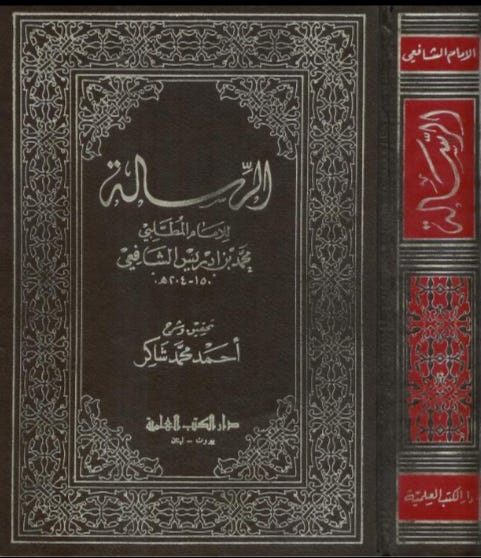
Muḥammad ibn Idrīs al-Shāfi‛ī, Al-Risāla, Ed. by Aḥmad Muḥammad Shākir with commentary, Maktabat Dār al-Turāth, 2005.
Muḥammad ibn Idrīs al-Shāfi‘ī, The Epistle on Legal Theory, Ed and Transl by Joseph E. Lowry, New York University Press, 2013.
Edward Said, Orientalism, Random House, 1978.
Muhammad Abu Zahra, The Four Imams: Their Lives, Works and Their Schools of Thought, Transl by Aisha Bewley, Dar al-Taqwa, 2001.
Jonathan A. C. Brown, Hadith: Muhammad’s Legacy in the Medieval and Modern World, Oneworld Publications, 2009.
Daniel W. Brown, Rethinking Tradition in Modern Islamic Thought, Cambridge University Press, 1999.
Christopher Melchert, “The Theory and Practice of Hadith Criticism in the Mid-Ninth Century”, Chapter 4 in Islam at 250: Studies in Memory of G.H.A. Juynboll, 2020.
John Burton, An Introduction to the Hadith, Edinburgh University Press, 1994.
Pavel Pavlovitch, “The Islamic Penalty for Adultery in the Third Century AH and Al-Shāfi‛ī’s Risāla,” Bulletin of the School of Oriental and African Studies 75, no. 3 (2012): 473–97.
Joseph E. Lowry, transl, al-Shāfi‘ī’s The Epistle on Legal Theory, 87.
Lowry, transl, al-Shāfi‘ī’s Epistle, 103.
al-Shāfiʿī, al-Risala, ed, Shakir, 201.
Aisha Bewley, transl, Abu Zahra’s The Four Imams, 287.
Melchert, “The Theory and Practice of Hadith Criticism”, 91, states that al-Shāfiʿī’s attempts to conduct hadith criticism were rare and followed “no systematic method.”
Lowry, transl, al-Shāfi‘ī’s The Epistle, 103.
al-Shāfiʿī, al-Risala, ed, Shakir, 213.
Brown, Hadith: Muhammad’s Legacy, 210.
Brown, Hadith: Muhammad’s Legacy, 204.
Burton, An Introduction to the Hadith, 121-2.
Burton, An Introduction to the Hadith, 121-2.
Pavlovitch, “The Islamic Penalty”, 478.
Daniel W. Brown, Rethinking Tradition in Modern Islamic Thought, 81.
Melchert, “The Theory and Practice”, 90.
Melchert, “The Theory and Practice”, 91.
Your Conception of Shafi'is Usuli methodology-his conception of Sunnah, and his reliance on the principle of commenting upon the content of the Ahadith (Sound too)- is new to me as a student of the Islamic Legal Theory, with a fresh perspective, perhaps. It would be every helpful if you could provide further readings on the similar reading of the Imams Usul.
I must mention though that the way you frame and structure your arguments, makes these academic reads easier than usual. Ma sha Allah.